

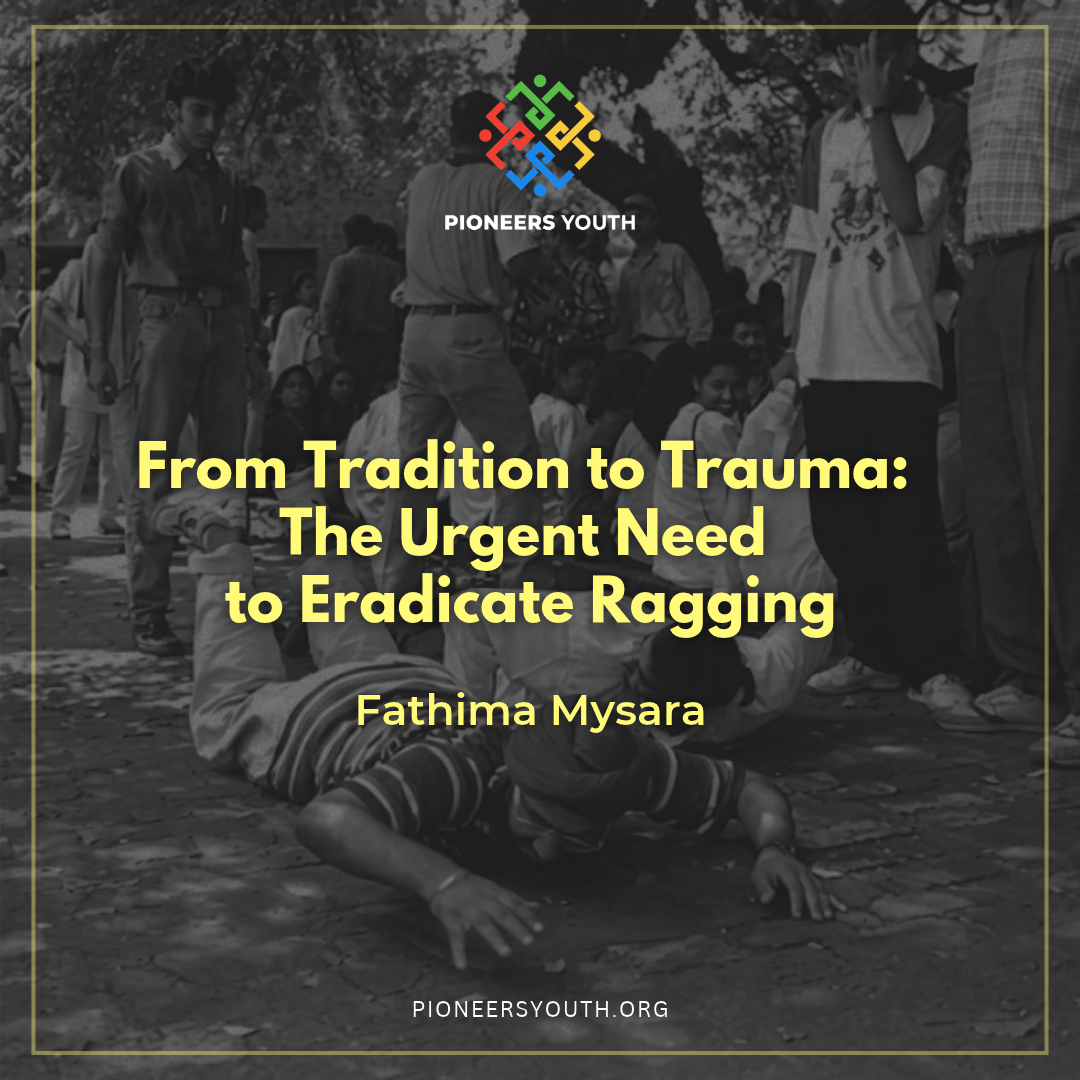
Ragging is the practice of seniors welcoming freshmen to the university with disorderly conduct. Some even call it the ‘Student Transformation Culture.’ It dates back to World War I, when young people returned from the war and enrolled in universities, where they carried out severe forms of ragging, which were practiced in army camps.
Ragging, or in other words, bullying, is carried out worldwide. It has become an international phenomenon, resulting in dark outcomes.
Students who have successfully obtained admission to higher education, after all their hard work and sleepless nights, are reluctant, or more accurately, afraid, to enroll in universities or colleges owing to the fear of being ragged. In some cases, students even drop the idea of higher education. All their dreams are crushed just because of some Student Transformation Culture.
In South Asian countries like Sri Lanka, India, Bangladesh, and Pakistan, ragging usually takes place in universities and colleges. Generally, such acts take place in lecture halls, cafeterias, libraries, and even outside the institution. Acts of minor ragging gradually turn into ugly scenarios. Freshers are abused physically, mentally, verbally, and even sexually. The conduct has been extreme, to the level of freshers committing suicide due to unbearable bullying. Sri Lanka has a dark history of such incidents; even reading about them is heartbreaking, as reported by the Sunday Times.
Ms. Hemamalie Gunatilaka’s research paper on ragging in Sri Lanka points out the causes for the prevalence of ragging, as analyzed by scholars. The major highlighted causes that struck me deeply are
- The eagerness of seniors to show off their power, authority, superiority, and influence over their junior students.
- Being a means of retaliation (seniors were ragged, so they also repeat the same with their juniors).
- Ragging is justified by these students on the grounds that it is the only way in which the new students can be taught about the traditions of the institutions. Furthermore, the senior students live under the misconception that these acts will put them in the ‘influential crowd.’
First things first, all students must know and understand this: ‘Senior’ and ‘Junior’ are merely two words, and neither possesses power nor hold any reason to be superior or inferior to anyone. Of course, senior students are responsible for shaping the freshers. However, the so-called Student Transformation Culture does not seem to be the appropriate way. History proves that forcing juniors to engage in uncomfortable activities, compelling them towards violence, and making them underdogs is clearly not the proper way. If deaths due to unbearable ragging cannot put an end to this, then I wonder what can?
People who conduct these insanely disgusting activities to transform the culture of students think that they are elevating the juniors when, in reality, they are bringing others down with them. Victims of ragging might not only be vulnerable to committing suicide, but additionally some live with long-term physiological or psychological problems.
This has to stop! The so-called power the senior students have bestowed upon themselves has to End! Shaping the next generation is a great responsibility for all of us. What we teach them is most likely what they will pass on to the next generation.
Working in unity will take us all a long way. Creating a culture of respect, courage, trust, and, most of all, harmony brewed out of nonviolence should be the way. Changes are needed so that freshers are familiarized with different life situations. But this adaptation must be taught through peaceful actions. Actions that are worth passing on to the next generation.
Why use harsh words when there are ways to ask people to do what you want with honest communication? Why force juniors to sing or dance in public when you can do so yourselves along with them as an encouragement? Why create an unnecessary gap between the senior and junior students when you can sit together in a cafeteria and share food? Why not create a highly esteemed image of yourself in the hearts of others? Why be arrogant when you can choose to be humble enough to walk shoulder-to-shoulder with a junior? Why choose sadism when you can spread happiness? Why create a power imbalance and increase discrimination when you can foster equality?
The goal of influencing other people’s lives is acceptable, but the existing practices are not. Respecting is acceptable, but victimization is not. Teaching is acceptable, but bullying is not.
Your actions should never be the reason someone feels discomfort, considers suicide, refrains from pursuing higher education, or sees their dreams shattered. You should never be the cause of someone experiencing the worst days of their college life.
There are many universities and other higher educational institutions worldwide that have moved away from these harsh treatments and instead focus on a more student-friendly environment. Also, many countries have implemented legal frameworks against ragging. However, ragging still persists and has not been completely eradicated yet. The Prohibition of Ragging and Other Forms of Violence in Educational Institutions Act was implemented in Sri Lanka with the goal of prohibiting ragging and other associated violent practices in educational institutions. Even so, in 2023, the Daily Mirror posted another case of ragging reported from Sri Jayawardenepura University, stating that “heads and facial hair of 15 students had been shaved with the same razor despite the health risks involved.”
Another case in 2020 was reported from the same university, stating that the petitioner was severely injured during a ragging incident when a backhoe tire was rolled over his body. The student had to face the consequences of being ‘hospitalized for nearly three months.’
If asked whether ragging still exists even today, the answer is a bitter ‘yes’. On April 29th, 2025, the body of Charith Dilshan, an engineering student at the Sabaragamuwa University of Sri Lanka, was found hanging in his backyard. According to his family and a fellow student, suicide was the outcome of severe psychological, physical, and sexual ragging.
Thus, the disciplinary bodies of relevant institutions and the government have a gigantic responsibility of seeing to the proper implementation of anti-ragging policies and laws. What is the point of a legal framework if the perpetrators are not immobilized under it while the number of victims keeps on increasing? Is suspension or any other form of average punishment enough to bring justice to these victims?
It requires a collective effort to put an end to these atrocities. Be it minor or major, bullying is still bullying. Change first takes place in the mindset. The next time you feel like ragging another, think, “What right do I have to control others?” And the next time you are being bullied, think, “What reasons do I have to be afraid of them?”
The obvious answer to both questions is absolutely nothing!