Today, an answer to almost any question arrives in three seconds: fluent, assertive, and complete. Something vanished in those three seconds, leaving no mark: the silence in which a thought is slowly produced, the awkward interval that has always been the workshop of original thinking.
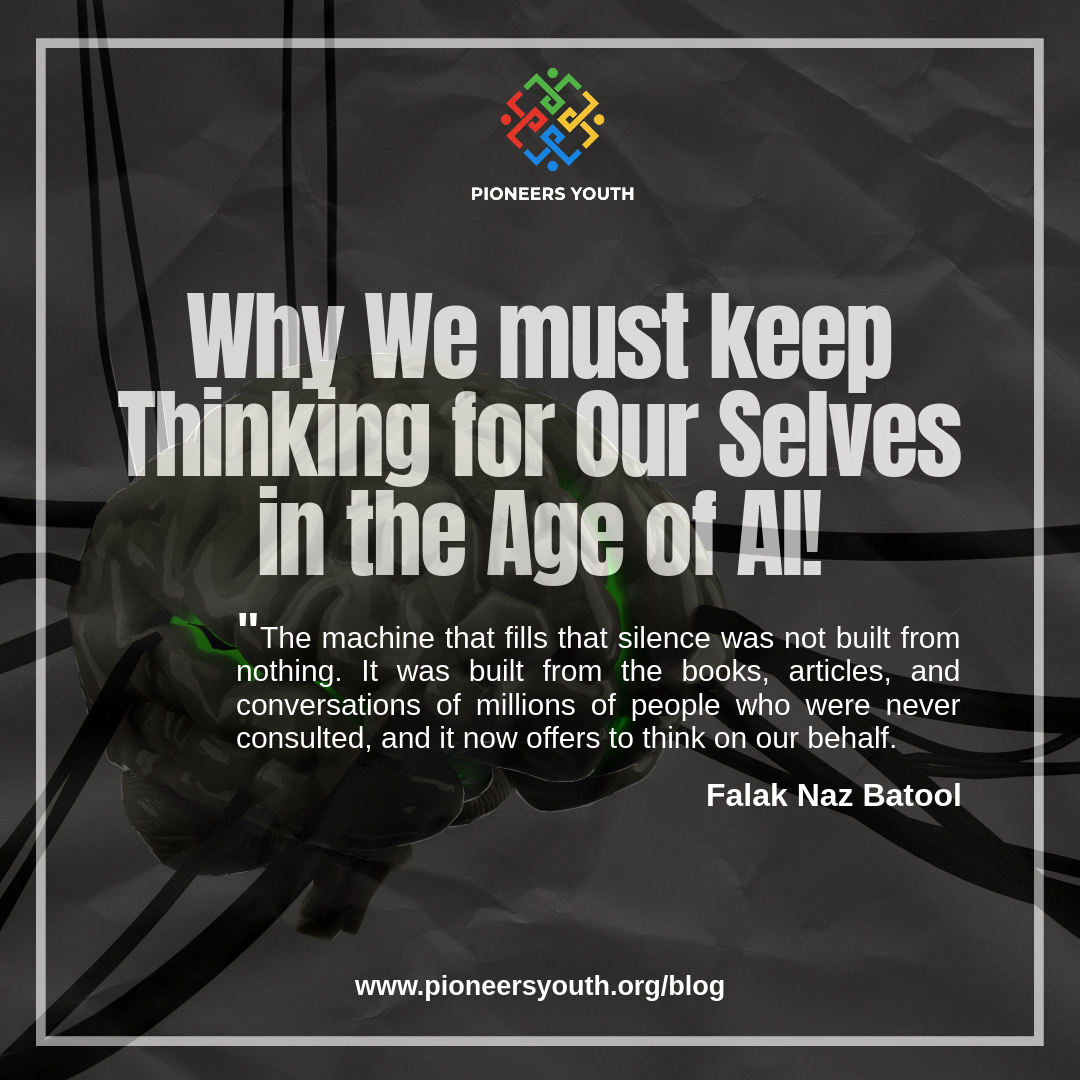
The machine that fills that silence was not built from nothing. It was built from the books, articles, and conversations of millions of people who were never consulted, and it now offers to think on our behalf. That double borrowing sits at the centre of the age of AI: the machine borrowed from humanity to learn how to speak, and humanity now borrows from the machine instead of thinking. Each borrowing creates an obligation, and this piece examines both.
Large AI models do not hold knowledge the way people do. They are trained on vast quantities of human writing from which they learn how words are assembled. This origin is now being tested in court. In December 2023, The New York Times sued OpenAI and Microsoft, alleging that millions of its copyrighted articles were used to train systems that now compete with the newspaper. The claims remain for the courts to resolve, but the case shows how directly a publisher can trace its own work into the machine.
The deeper question which remains is what a made thing owes to the people who made it. When Hayao Miyazaki, co-founder of Studio Ghibli, was shown an early AI animation in 2016, he called it “an insult to life itself”. His reaction was to one disturbing demonstration and should not be read as a verdict on today’s tools, but the instinct behind it holds: the machine has never struggled over a sentence, a drawing, or a melody, and every trace of that struggle in its output was left there by someone who did. Therefore, those people deserve acknowledgement, credit, and fair terms.
The second borrowing runs in the opposite direction and is harder to notice because it arrives as a convenience. A 2024 survey of 354 students at one Pakistani university, published in the iRASD Journal of Educational Research, captures the ambivalence. The data revealed that fifty-one per cent of students used ChatGPT regularly; 68 per cent agreed that its use weakens critical thinking, while 72 per cent said it sharpened their own critical thinking ability. Most students denied relying on ChatGPT, yet 75 per cent believed their classmates did. Few acknowledged their own dependence, but most observed it on someone else’s account.
Neuroscience offers a less flattering picture. In a 2025 MIT Media Lab preprint, 54 participants wrote essays with ChatGPT, with a search engine, or with no tools at all, while EEG headsets recorded their brain activity. As outside help increased, connectivity between brain regions weakened, and the ChatGPT group struggled to recall what they had written only minutes earlier. The researchers named the pattern cognitive debt, where effort was borrowed and never repaid. Educators report related effects: weaker creative writing, shorter attention spans, and greater exposure to misinformation, since a mind trained to accept a fluent answer is poorly positioned to notice when the answer is wrong.
This is not the first time a machine has inspired fear. About 2,400 years ago, Socrates worried that writing would weaken memory, warning, in Plato’s account, that people who relied on written words would seem wise without truly understanding. The printing press, the calculator, and the search engine each drew a version of the same worry. Arithmetic did not disappear, and knowledge was not erased. What shifted was where the effort went, yet the worry was not wholly misplaced: a 2011 study in Science found that people remember information less reliably when they expect to find it online again. But what sets this moment apart is how the technology works. Earlier machines processed what we supplied. Today’s tools hand us a finished idea, and it can feel as though we conceived it ourselves, which is precisely the gap Socrates described between understanding and the appearance of understanding.
The cost is unevenly distributed. As adults who built their judgment before these tools arrived can at least detect when a machine has erred. Children and teenagers are building that judgment now, and a machine that answers every question before they have struggled with it removes the very struggle through which judgment forms.
Refusing AI altogether is therefore no longer realistic, as these tools now sit inside search engines, word processors, and phones, and specialists concede that complete distancing is almost impossible. The question has therefore shifted to how much thinking they should be allowed to carry. A workable response rests on three commitments to help settle both debts:
- Individuals should think first and ask second, drafting the outline or a first attempt at the problem before opening the tool and then asking it to find the weakest joint in what has been made, so that the machine checks an idea instead of supplying one.
- Schools and universities should publish explicit guidelines on responsible use, introduce digital-literacy frameworks, and present the tool as support rather than a substitute.
- The writers, journalists, and artists whose work taught the machine to write must be acknowledged and paid fair compensation.
This leaves us with one central question: whether these tools expand human cognitive capacity or offer a shortcut around critical thinking? The answer depends on whether we use them as scaffolding or as substitutes. Scaffolding supports the work that the builder is still doing, falling away once the structure stands; a substitute does the work and leaves no skill behind. The machine will always be ready to fill that awkward pause, the very interval in which a thought becomes yours. Therefore, before the next prompt, we should leave room for the silence in which an original thought might form. In doing so, we repay our own debt and make it easier to insist that the machine’s makers repay theirs.